
Professional water tank cleaning in the UAE follows a fixed sequence: inspection, draining, sludge removal, manual scrubbing, high-pressure washing, disinfection, rinsing, refilling, water testing, and a compliance report. Done properly, the whole job takes 2 to 6 hours for a villa tank and longer for building tanks. If a company skips the scrubbing or the disinfection stage, the tank is not clean, no matter what the invoice says.
This guide walks through exactly what a certified team does inside your tank, why each step matters in UAE conditions, and how to tell if the company you hired actually did the work. Quality Care UAE has cleaned tanks for villas, towers, hotels, and labor accommodations across all 7 emirates, and this is the process our technicians follow on every job.
Need your tank cleaned this week? Call or WhatsApp +971 56 565 6825 for a free quote.
Why the Process Matters More in the UAE Than Anywhere Else
Most homes and buildings in the UAE store water in rooftop or underground tanks before it reaches your taps. That stored water sits at 35°C to 45°C for months during summer. Warm, still water is exactly what algae and bacteria need to grow. Add fine sand and dust entering through vents and loose lids, and you get a layer of sediment at the bottom of the tank within weeks.
This is why municipalities across the UAE require tanks to be cleaned and disinfected by an approved contractor at regular intervals. A quick rinse does not meet that standard. The full process below is what inspectors expect to see documented.
The 10-Step Professional Water Tank Cleaning Process
Step 1: Pre-Cleaning Inspection
Before touching the water, the technician inspects the tank from outside and inside. This includes:
- Tank type and material (GRP, concrete, plastic, or steel)
- Capacity, to plan chemical dosing and time
- Condition of the lid, seals, and overflow pipes
- Visible algae, rust, cracks, or sediment level
- Access points, ladders, and safety hazards
For underground and large rooftop tanks, our team takes photos at this stage. These become the “before” evidence in your final report. If we find structural damage such as cracks or a corroded float valve, we tell you before starting, not after.
Step 2: Isolating the Water Supply
The inlet valve is shut so no fresh water enters during cleaning. The outlet to the building is also closed. This stops dirty water, loosened sediment, and cleaning chemicals from reaching your taps.
For occupied buildings, we coordinate timing with the facility manager so residents know water will be off for a few hours. For villas, we usually schedule mornings so supply is restored by afternoon.
Step 3: Draining the Tank
The tank is drained using a submersible pump or the drain valve. Water is directed to a suitable drainage point, never onto the roof surface where it can leak into the building below.
A common shortcut by unlicensed cleaners is to drain only half the tank and “clean” the exposed walls. The bottom sludge stays. A proper drain empties the tank completely so the floor is fully accessible.
Step 4: Sludge and Sediment Removal
Once drained, a layer of sediment remains on the tank floor. In UAE tanks this is usually a mix of sand, dust, mineral scale, and biofilm. It can be 1 to 3 cm thick in tanks that have not been cleaned for a year or more.
Technicians remove this using wet vacuums and scoops. It is bagged and disposed of, not flushed down the drain where it can block pipes.
Step 5: Manual Scrubbing of Walls, Floor, and Ceiling
This is the step that separates real cleaning from a cosmetic rinse. Every internal surface is scrubbed by hand with soft-bristle brushes and a food-grade cleaning agent. This removes:
- Algae film on the walls (usually green or black)
- Slime or biofilm, which is where bacteria colonies live
- Scale deposits from hard water
- Rust staining on steel tanks
Corners, the area around the inlet and outlet pipes, and the underside of the lid get extra attention because they are where growth hides. For GRP and plastic tanks we use non-abrasive brushes so the surface is not scratched, because a scratched surface gives bacteria more places to attach.
Our technicians wear full PPE and use confined-space safety procedures when working inside large tanks.
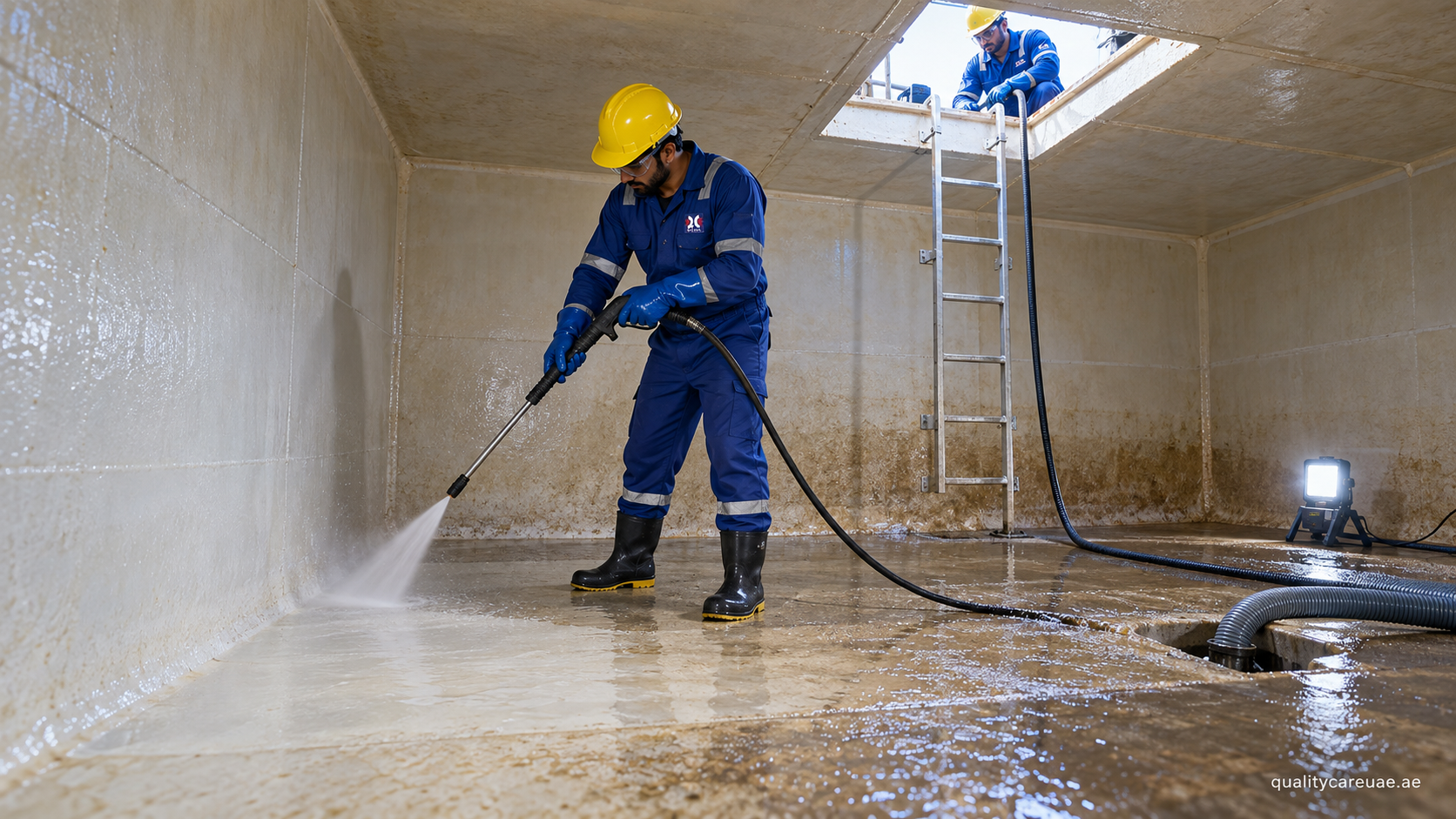
Step 6: High-Pressure Washing
After scrubbing, all surfaces are washed with a high-pressure jet. This flushes out the loosened material and reaches spots brushes cannot fully cover, such as seams and pipe joints. Wastewater is pumped out again so nothing is left standing in the tank.
Step 7: Disinfection
The tank is now physically clean but not yet safe. Disinfection kills the bacteria that scrubbing alone cannot remove.
We apply an approved chlorine-based disinfectant to all internal surfaces, at a concentration suitable for potable water tanks. The solution is left in contact with the surfaces for the required contact time, typically 30 to 60 minutes depending on the product and tank condition. This step is mandatory for municipality compliance, and the product used should be listed on your service report.
For tanks with a history of contamination or a failed water test, we may also disinfect the inlet and outlet pipework.
Step 8: Final Rinsing
The disinfectant is completely rinsed out with clean water, and the rinse water is drained. This is repeated until residual chlorine returns to a safe drinking-water level. Skipping or rushing this step leaves a strong chlorine taste in your water for days.
Step 9: Refilling and System Check
The inlet valve is reopened and the tank is refilled. The technician checks:
- Float valve operates correctly and stops at the right level
- No leaks at the outlet after reconnection
- Lid is sealed and vent screens are in place to keep insects and dust out
Water supply to the building is then restored.
Step 10: Water Testing and Compliance Report
On completion, we collect a water sample for testing. Depending on your requirement and property type, this can be an on-site test for chlorine level, pH, and turbidity, or a full laboratory analysis for bacterial contamination.
You receive a service report that includes:
- Before and after photos
- Date of cleaning and next due date
- Chemicals and concentrations used
- Water test results
- Company trade license and approval details
This report is what you show a municipality inspector, your building management, or a tenant who asks when the tank was last cleaned. Keep it on file.
How Long Does the Full Process Take?
| Tank Type | Typical Time |
|---|---|
| Villa rooftop tank (1,000 to 5,000 gallons) | 2 to 4 hours |
| Apartment building tank | 4 to 8 hours |
| Large commercial or underground tank | Full day, sometimes 2 days |
Time depends on tank size, how long since the last cleaning, access, and whether repairs are needed. We give you a realistic estimate at the inspection stage.
What a Bad Water Tank Cleaning Looks Like
Property owners often pay for a “cleaning” that was only a rinse. Warning signs the job was not done properly:
- The team finished a 5,000-gallon tank in 45 minutes
- No scrubbing brushes or pressure washer were used, only a hose
- No disinfectant was applied, or they cannot tell you what product was used
- No before and after photos
- No written report, or a report with no company license number on it
- Water still smells musty or looks cloudy a day later
If you got any of these on your last service, the tank is likely still contaminated.
Can You Clean a Water Tank Yourself?
Technically yes, for a small tank. In practice, most owners should not. Confined-space entry inside a tank is a real safety risk, disinfectant dosing needs to be measured correctly for potable water, and a DIY clean does not produce the compliance certificate that municipalities and building management ask for. For rented properties and commercial buildings, a self-clean will not satisfy an inspection.
How Often Should the Process Be Repeated?
Municipalities in the UAE require tanks to be cleaned at regular intervals by an approved contractor, and higher-risk premises like hotels, schools, hospitals, and labor accommodations are held to a stricter schedule. Contact your local municipality or ask us for the frequency that applies to your property type and emirate. Between professional cleanings, keep the lid sealed, check for algae monthly, and book a cleaning right away if water changes in smell, taste, or color.
Why Book Quality Care UAE for Water Tank Cleaning
- Operating in the UAE for over a decade, serving villas, towers, hotels, and industrial sites
- Ajman Municipality approved contractor, with certificates available on request
- Full 10-step process on every job, never a rinse-and-go
- Before and after photo documentation and a compliance report with every service
- Trained technicians with confined-space and PPE protocols
- Service across Dubai, Abu Dhabi, Sharjah, Ajman, Ras Al Khaimah, Fujairah, Umm Al Quwain, and Al Ain
See our full water tank cleaning service page, or go straight to your emirate: Abu Dhabi, Sharjah, Ajman, Ras Al Khaimah, Fujairah, Umm Al Quwain, or Al Ain.
Book Your Water Tank Cleaning
Call or WhatsApp +971 56 565 6825 to get a free quote. Tell us your tank type, approximate size, and location, and we will confirm a time and price the same day.
Frequently Asked Questions
Will my water be off during the cleaning?
Yes, for the duration of the job. For a villa this is usually 2 to 4 hours. We schedule around your routine and restore supply as soon as the tank is refilled.
Is the disinfectant safe for drinking water?
Yes. We use chlorine-based disinfectants approved for potable water tanks and rinse thoroughly until residual levels are within safe drinking-water limits.
Do you clean both rooftop and underground tanks?
Yes. Underground tanks need confined-space procedures and pumping equipment, which our teams carry as standard.
Will you tell me if my tank has damage?
Yes. The inspection stage is for exactly this. If we find cracks, a failing float valve, or heavy corrosion, we report it before starting and you decide how to proceed.
Do I get a certificate after the cleaning?
You receive a full service report with photos, chemicals used, water test results, and our license details. This is what building management and municipality inspectors ask for.
Can you clean the tank and the AC ducts on the same visit?
Yes. Many clients combine AC duct cleaning with tank cleaning to reduce site visits. Ask for a combined quote.

