
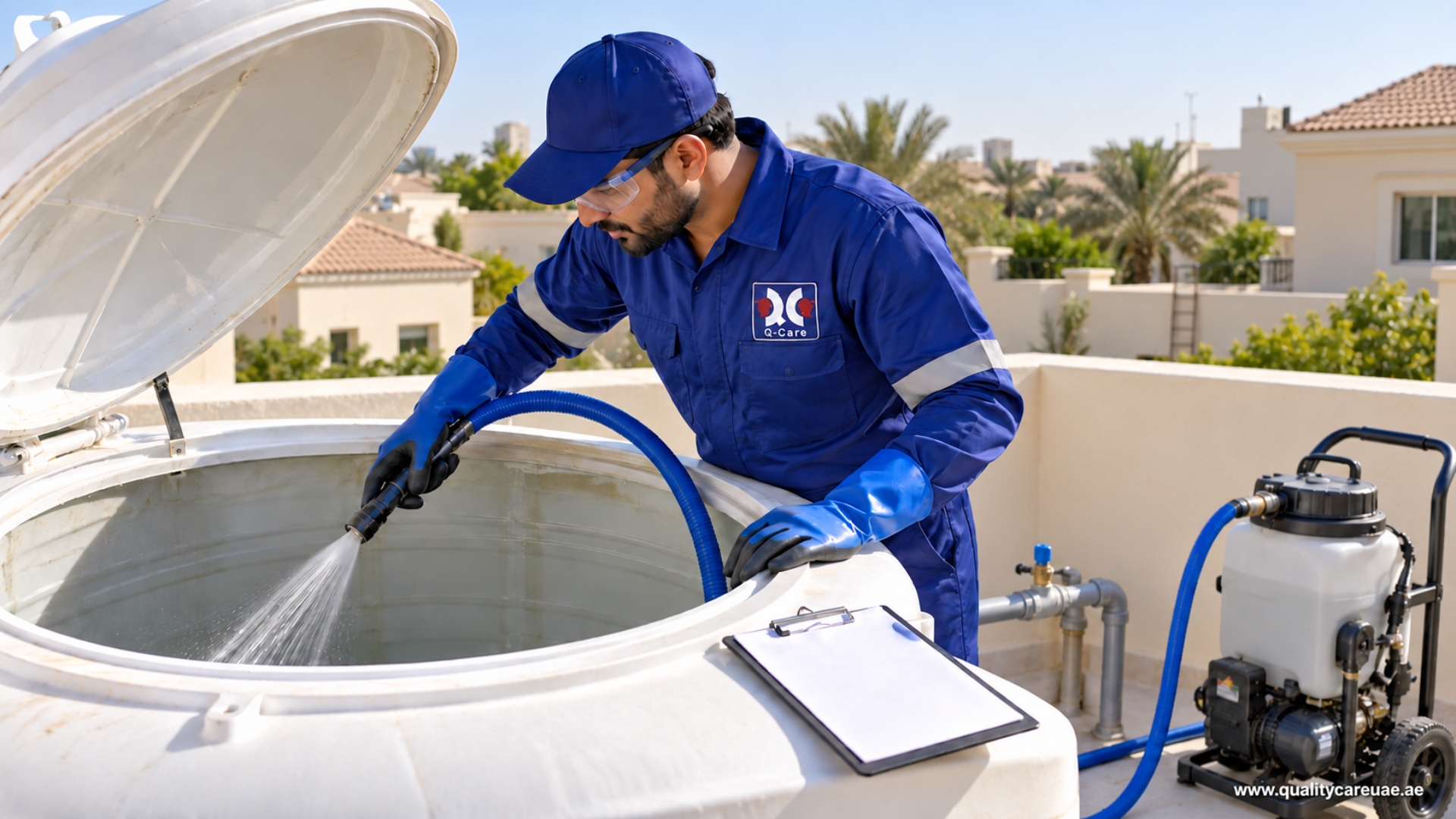
If you own or manage a property in Abu Dhabi, you are legally responsible for the water stored in its tanks. Abu Dhabi Distribution Company (ADDC) delivers clean water to your meter, but from that point onward, the tank, the pipes, and the water quality at your taps are your responsibility.
Here is the short version: most tanks in Abu Dhabi must be cleaned and disinfected at least once a year, and many must be cleaned twice a year. The work has to be done by a registered company, tenants must be notified in advance, and you have to keep records for 5 years. Municipality inspectors can check your building at any time.
This guide explains what the rules actually say, who they apply to, and how to stay on the right side of them. If you want to book a compliant service now, call Quality Care UAE on +971 56 565 6825 or visit our water tank cleaning in Abu Dhabi page.
Which regulation covers water tanks in Abu Dhabi?
The main document is the Code of Practice for the Inspection and Cleaning of Customer Water Storage Tanks, publication number ED/R01/102. It was issued in January 2015 by the Regulation and Supervision Bureau (RSB), which has since become part of the Abu Dhabi Department of Energy (DoE). The code came into force on 1 January 2015 and is still the reference document published on the DoE website.
The code supports 2 higher-level regulations: the Water Supply Regulations and the Water Quality Regulations, both issued under Law No (2) of 1998. Enforcement on the ground is handled by the municipalities (Abu Dhabi City Municipality, Al Ain City Municipality, and Al Dhafra Region Municipality) with support from the distribution companies.
The code applies to every customer water storage tank in the Emirate of Abu Dhabi up to 2,270 cubic meters (500,000 imperial gallons), regardless of the tank material, shape, or location. That covers villas, apartment buildings, towers, labor camps, hotels, schools, hospitals, mosques, malls, restaurants, and industrial sites.
Who is legally responsible?
The code uses the term “Responsible Person.” This means the building owner, or the registered building manager or agent who has been engaged by contract to maintain the building.
In practice:
- For a private villa, the homeowner is the Responsible Person.
- For a residential tower or commercial building, it is the owner or the facilities management company.
- Tenants in a multi-unit building have no direct obligation for the tank, but they have the right to ask building management for cleaning and test records.
The Responsible Person must engage a “Responsible Company.” This is a cleaning or inspection company that is licensed and registered in Abu Dhabi to do this work. Hiring an unregistered contractor does not satisfy the code, even if they do a good job.
How often must you clean your tank in Abu Dhabi?
This is where most online guides get it wrong. The Abu Dhabi code does not set one blanket frequency for everyone. The minimum depends on what your tank is made of and where it sits.
Here is the minimum cleaning and disinfection frequency from Table 5.1.1 of the code, which applies to both residential and commercial buildings:
| Tank material | Tank location | Minimum frequency |
|---|---|---|
| Concrete | Underground | Every 6 months |
| Concrete | Ground level | Every 6 months |
| Concrete | Roof | Once a year |
| Plastic (polyethylene) | Ground or roof | Once a year |
| FRP (fiberglass) | Ground or roof | Once a year |
| GRP (glass reinforced plastic) | Ground level | Every 6 months |
| GRP (glass reinforced plastic) | Roof | Once a year |
| GI or GS (galvanized) | Ground or roof | Once a year |
A few things to note:
- These are minimums. The code allows and expects more frequent cleaning where usage is heavy or contamination is found.
- Concrete and GRP tanks at ground level need cleaning twice a year because they are more prone to sediment and biofilm.
- Since December 2012, the construction of new underground (buried) water tanks in low-rise residential buildings has been banned in Abu Dhabi. Existing ones are still covered by the code.
- If an inspector or a water test finds contamination, you must arrange cleaning within 48 hours, regardless of when the last cleaning was done.
Many facilities managers in Abu Dhabi choose a 6-month cycle for all tanks to keep things simple and to reduce the risk of a failed inspection. Hotels, hospitals, schools, and food premises commonly go to quarterly cleaning as best practice, though the code itself sets the minimums above.
What counts as a compliant cleaning?
Simply flushing the tank with water does not meet the standard. The code sets out a specific procedure that a registered company must follow. The main steps are:
- Notify tenants at least 48 hours before the cleaning date.
- Shut the inlet valve at least 24 hours before, so the stored water gets used rather than wasted.
- Lock out and tag all inlet and outlet valves.
- Open the tank cover and ventilate for 20 minutes, then test gas and oxygen levels before anyone works near or inside the tank.
- Drain the tank to below 100 mm.
- Scrub or pressure-wash every internal surface, including the cover and entry points, using approved food-grade cleaning chemicals if needed.
- Rinse and drain the wastewater.
- Apply disinfectant to all internal surfaces. Only food-grade sodium hypochlorite or calcium hypochlorite is permitted, at concentrations up to 20 mg/l, unless another disinfectant has been approved by the regulator.
- Leave the disinfectant for a minimum of 30 minutes.
- Rinse again, drain, and refill with potable water.
- Take a water sample for laboratory testing where required.
If a building has both an underground tank and a roof tank that are connected, the underground tank must be cleaned first to avoid cross-contamination.
The company also has to carry out an environment, health, and safety risk assessment before starting, because tank cleaning involves confined spaces, working at heights, and chemical handling.
Water testing after cleaning
Testing is not optional for every property. The code says that reinforced concrete underground tanks, ground-level tanks, and any tank larger than 100 cubic meters must always be tested after cleaning. For other tanks, testing is required when contamination is suspected or when an inspector asks for it.
Samples must go to an ISO 17025 accredited laboratory licensed in Abu Dhabi. The water must meet these limits:
| Parameter | Limit |
|---|---|
| Total coliforms | 0 per 100 ml |
| E. coli | 0 per 100 ml |
| Total bacterial count | 10 per 1 ml at 37°C |
| Legionella | 0 cfu/ml |
| Total residual chlorine | 0.2 to 1.0 mg/l |
Results for bacterial count, E. coli, and coliforms should come back within 3 days, and Legionella within 6 days.
One important rule: the company that cleaned your tank is not allowed to take the sample from that same tank. Sampling and testing must be done by a separate registered inspection company to avoid any conflict of interest. Ask your provider how they handle this.
What happens if a test fails?
If a sample comes back non-compliant, the Responsible Person must:
- Notify all residents and tenants within 2 hours that the water is unfit for use, by a written notice delivered to each unit and posted at all common entry points.
- Arrange a registered company to clean and disinfect again within 48 hours.
- Report the non-compliant result in writing to ADDC and the relevant municipality.
All tenant notices must be in both Arabic and English, and in other languages if the building’s residents need them.
Tenant notification rules
Even for routine cleaning, the code requires you to inform residents:
- At least 2 days before the planned cleaning, with the date, time, how long the water will be off, and any precautions.
- Cleaning should be scheduled on normal working days and hours to limit disruption.
- After completion, a notice confirming the water is safe to use, along with advice such as running taps and showers for at least 5 minutes before use.
Notices go to each unit and are posted in common areas, in Arabic and English.
Records you must keep
Abu Dhabi treats documentation as seriously as the cleaning itself. The Responsible Person must keep:
- Cleaning and disinfection certificates from the registered company
- Inspection and sampling checklists (Appendix B of the code)
- Laboratory test reports, signed and acknowledged
- Copies of any reports sent to ADDC or the municipality
All of these must be retained for 5 years and made available to municipality inspectors or the Department of Energy on request. Keep them in a building file that a manager can produce quickly during an inspection.
Municipality inspections
Inspections in Abu Dhabi are risk-based and can be random or unannounced. Inspectors decide where to visit based on factors like building age, building type, population density, tank type and location, and past inspection records.
During a visit, they will check your cleaning records and also look inside the tanks for visible signs of contamination. The code lists these warning signs:
- Sediment or sludge on the tank floor
- Algae growth
- Oily film on the water surface
- Dead animals or insects
- Extensive corrosion
- An uncovered opening
- Dirt or algae around the manhole or tank surroundings
- Nearby oil, chemical, or sewage leaks
If any of these are found, you will be required to clean the tank, regardless of when it was last done.
Penalties for non-compliance
The code states that serious and repeated non-compliance can lead to penalties and enforcement under the Water Supply Regulations and Water Quality Regulations. Repeat offenders can face further action under related regulations, and registered cleaning companies can have their licenses suspended or cancelled.
You may see specific fine amounts quoted on other websites. The published code does not list fixed amounts, and penalties are applied case by case by the enforcing authority. For the current position, contact Abu Dhabi City Municipality or the Department of Energy directly rather than relying on figures from a blog.
Why Abu Dhabi’s climate makes this more urgent
Abu Dhabi’s environment works against stored water. Summer temperatures regularly exceed 45°C, which warms rooftop tanks and speeds up bacterial growth. Fine desert dust and sand find their way through loose covers and vents, settling as sediment. Coastal humidity in the city and the harsher dry heat in Al Ain and Al Dhafra both create conditions where biofilm and algae develop faster than in cooler climates.
This is why the minimum frequencies in the code should be treated as a floor. A tank that looks fine at 6 months in a cooler country can be visibly contaminated in the same period here.
A simple compliance checklist for Abu Dhabi property owners
- Know your tank material and location, and match it to the frequency table above
- Use only a licensed, registered cleaning company
- Confirm that sampling is done by a separate registered inspection company where testing is required
- Notify tenants 48 hours before cleaning, in Arabic and English
- Get a cleaning certificate and lab report after every service
- Keep all records for 5 years in a building file
- Set calendar reminders so you never pass the deadline
- Act within 48 hours if an inspector or test flags a problem
Book compliant water tank cleaning in Abu Dhabi
Quality Care UAE provides water tank cleaning and disinfection across Abu Dhabi, Al Ain, and the rest of the UAE for villas, residential buildings, commercial properties, and industrial sites. Our teams follow the Abu Dhabi Code of Practice step by step, use only approved food-grade disinfectants, and provide the documentation you need for municipality inspections.
Call us on +971 56 565 6825 or message us on WhatsApp to schedule a service or request a quote. You can also learn more about our water tank cleaning services across the UAE.
Frequently asked questions
How often should a villa water tank be cleaned in Abu Dhabi?
It depends on the tank. A concrete or GRP tank at ground level must be cleaned every 6 months. Plastic, fiberglass, galvanized, and roof-mounted tanks must be cleaned at least once a year. Many villa owners choose 6-month cleaning regardless, given the local heat and dust.
Is water tank cleaning mandatory for private villas in Abu Dhabi?
Yes. The code applies to all customer water storage tanks in the emirate, and for a private villa the homeowner is the Responsible Person.
Can I clean my own water tank?
The code requires cleaning and disinfection to be carried out by a licensed and registered Responsible Company. Self-cleaning does not produce the certificate or records that inspectors will ask for, and tank work involves confined-space and chemical risks.
What documents should I receive after a cleaning?
A cleaning and disinfection certificate, the inspection and sampling checklist, and where testing was done, an accredited laboratory report. Keep all of them for 5 years.
Do I need to test the water after every cleaning?
Testing is always required for reinforced concrete underground and ground-level tanks and for any tank over 100 cubic meters. For other tanks, it is required when contamination is suspected or an inspector requests it.
Who enforces water tank rules in Abu Dhabi?
The municipalities carry out inspections and audits, with regulatory oversight from the Abu Dhabi Department of Energy (formerly RSB). ADDC coordinates on water quality issues.
What if my tenants complain about water smell or color?
Treat it as a suspected contamination. Arrange an inspection and, if needed, cleaning within 48 hours, notify residents, and keep a record of the action taken.

